
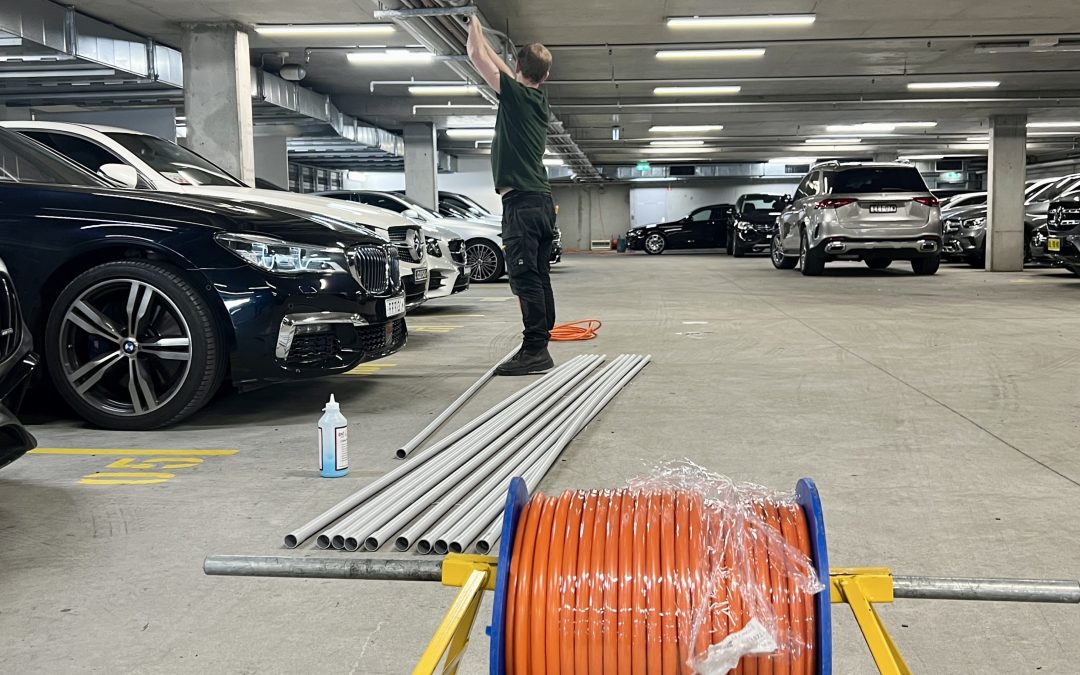
EV Charging Backbone for Strata Buildings in Sydney: Level 1 Infrastructure Guide
Most Sydney strata buildings aren’t ready to install a dedicated EV charger at every parking bay.
The electrical capacity may not support it. Resident demand isn’t there yet. The owners corporation isn’t ready to commit to a full rollout.
Level 1 EV charging infrastructure is the answer for buildings in this position.
It installs the core electrical backbone throughout the car park, so the building is EV-ready and individual chargers can be connected as residents request them, without requiring major electrical rework each time.
What Is Level 1 EV Charging Infrastructure?
Level 1 refers to the first stage of EV charging investment for a strata building: laying the electrical groundwork throughout the car park without committing to a charger at every bay.
The term doesn’t describe charging speed. It describes the infrastructure approach: building the backbone first, connecting chargers to it progressively as demand grows.
Think of it as installing the water pipes throughout the building before deciding where every tap goes. Once the pipes are in place, connecting a tap is simple and inexpensive. Without them, every new charger requires its own dedicated run from the source.
What Does Level 1 Infrastructure Include?
A Level 1 installation for a Sydney strata building typically includes:
- A dedicated EV charging backbone running throughout the car park: cable, busway or cable containment, providing reticulation to parking spaces and charging zones
- Distribution boards or EV switchboards sized for current connection requirements with headroom for future expansion
- Spare capacity and circuit protection (MCBs and RCBOs) so future circuits can be added without major rework
- Cable trays, conduits and defined pathways from the backbone to individual parking spaces or charging zones
- Load management systems where the building’s available electrical capacity needs to be shared across multiple charging points
- Energy metering and communications infrastructure for monitoring usage and billing residents for their electricity
- Fire-stopping, testing, commissioning and compliance documentation
Level 1 vs Level 2: Which Does Your Building Need?
The choice depends on current EV demand in your building and your available electrical capacity.
| Level 1 Backbone | Level 2 Per-Bay AC | |
|---|---|---|
| What’s installed | Electrical infrastructure only | Infrastructure plus chargers at each bay |
| Residents who can charge immediately | Those who request a bay connection | All nominated bays from day one |
| Upfront cost | Lower | Higher |
| Best when EV adoption is | Emerging (5–20% of residents) | Established (20%+ of residents) |
| Expandability | High: add chargers without rework | Moderate: add to existing backbone |
| OC approval difficulty | Generally easier to pass | Higher budget requires stronger consensus |
Level 1 is the right choice when EV demand is present but not yet widespread, when the building’s electrical capacity is limited, or when the owners corporation wants a staged investment that can be approved at a lower budget threshold.
Level 2 per-bay installation makes more sense when a significant proportion of residents already have EVs and want dedicated charging at their own bay from day one.
When Is Level 1 the Right Choice?
EV adoption is emerging but not yet widespread.
If 5 to 20 per cent of residents currently drive an EV or plan to within the next year or two, a full Level 2 rollout across all bays is oversized and expensive. Level 1 installs the backbone now and allows connections to be added as individual residents request them.
The building’s electrical capacity is limited.
Older Sydney apartment buildings, particularly those built before the 1990s, frequently have main switchboards and car park distribution boards with limited spare capacity. Level 1 infrastructure, combined with a load management system, allows EV charging to proceed within existing electrical limits without requiring an expensive mains supply upgrade at the outset.
The OC wants a staged investment approach.
Presenting a large per-bay rollout to lot owners at an AGM is a hard vote to win. A Level 1 proposal that enables resident charging now and scales on demand is an easier motion to pass, and it is the right technical decision for most Sydney buildings at current EV adoption rates.
When Is Level 1 Not Enough?
Level 1 infrastructure alone does not provide a charger at each resident’s bay. If your building has a significant number of residents who already drive EVs and want dedicated charging at their allocated space now, Level 1 on its own will not meet that demand immediately.
In that case, the right approach is usually to install Level 1 infrastructure and connect a number of Level 2 chargers to it at the same time, with the backbone sized to support further charger additions as demand grows.
If EV adoption in your building is already high across many bays, proceeding directly to a full Level 2 rollout may be more cost-effective than staging the infrastructure separately.
How Does Level 1 Infrastructure Support Future Expansion?
A well-designed Level 1 installation anticipates future demand from the start.
When a resident wants to add a charger at their bay, the conduit and pathway are already in place. Connecting a charger is a straightforward addition to the existing backbone rather than a new infrastructure run. This keeps the cost of individual bay additions low and predictable.
As the number of connected chargers grows, the load management system automatically optimises how the building’s available electrical capacity is shared. If five chargers are connected but the building can only support three running simultaneously at full power, the system dynamically adjusts charging rates so all five residents can charge without tripping protection equipment.
When future resident demand and electrical capacity allow, Level 1 infrastructure supports a straightforward upgrade to AC charging across all bays. The backbone, distribution boards and metering infrastructure do not need to be replaced.
What Does Level 1 Infrastructure Cost for a Sydney Strata Building?
There is no standard price because every building is different.
The main factors affecting cost include:
- Number of parking bays and levels
- Length and complexity of cable runs from the main switchboard
- Condition and capacity of existing switchboards and distribution boards
- Whether load management is required
- Metering and communications requirements
- Civil works and cable containment
- Fire-stopping requirements
A Level 1 backbone for a 40 to 80 bay car park in a Sydney apartment building typically starts from $15,000 to $40,000. An accurate quote requires a site assessment.
Following the feasibility study, we provide a fixed-price quote so your owners corporation has a confirmed figure before the approval vote.
EV Charging Backbone Installations in Sydney Car Parks
Sydney apartment buildings present a range of installation considerations that make proper upfront planning essential.
Underground car parks, common in buildings across the CBD, Inner West and Eastern Suburbs, often have long cable routes from the main switchboard to the car park levels. Cable size and containment requirements are determined by these distances, and they have a significant effect on both infrastructure cost and available electrical capacity at the point of delivery.
Older buildings frequently have car park distribution boards with no spare capacity. In these cases, the Level 1 scope includes replacing or supplementing existing boards alongside installing the charging backbone, which needs to be assessed and costed before any commitment is made.
Multi-level basements require careful design of the backbone routing to ensure the infrastructure can serve all levels without redundant cable runs or unnecessary rework when chargers are added later.
How Does the Installation Process Work?
- Feasibility and site assessment. We assess your building’s existing electrical infrastructure, car park layout and EV demand. We collect actual electrical usage data via on-site data logging. This takes 3 to 4 weeks from site access being confirmed.
- Fixed-price proposal. We provide a proposal covering the Level 1 scope of works, sized for current demand with headroom for future expansion.
- Strata committee or OC approval. Works on common property require a committee or general meeting resolution. We can attend your AGM to present the proposal and answer questions from lot owners.
- Installation. Our licensed electricians complete the backbone installation with full cable management, labelling, load management configuration and metering setup. A standard Level 1 installation for a 40 to 80 bay car park typically takes 3 to 5 days on site.
- Commissioning and handover. All infrastructure is tested and commissioned. Your building manager receives full documentation covering equipment operation, maintenance requirements and warranty terms.
Planning EV Charging Infrastructure for Your Sydney Strata Building?
Sydney EV Chargers installs Level 1 EV charging backbone infrastructure for apartment buildings, strata complexes and managed car parks across Sydney.
We can assess your building’s:
- Existing electrical capacity and available headroom
- Car park layout and cable routing options
- Current and projected EV demand
- Load management requirements
- Metering and billing approach
- Scope for future charger additions
Call 1300 905 641 or contact Sydney EV Chargers to arrange a strata EV charging assessment.
Installing the backbone now means every future charger connection is simple. Skipping it means every addition is a new project.
Further Reading
- EV Charging for Strata Buildings Sydney — our full strata EV charging service page
- EV Charging Feasibility Study for Strata Buildings
- Level 2 AC EV Charging for Strata Apartments